Preference Flows in the Farrer By-Election
One Nation claimed their first House of Representatives seat last month in Farrer. But how did they do it, and by how much did Coalition preferences favour them?
Building off my recent post about One Nation's performance in South Australia, I thought I'd analyse the preference flows at the Farrer by-election, now fully published on the Australian Electoral Commission's website.
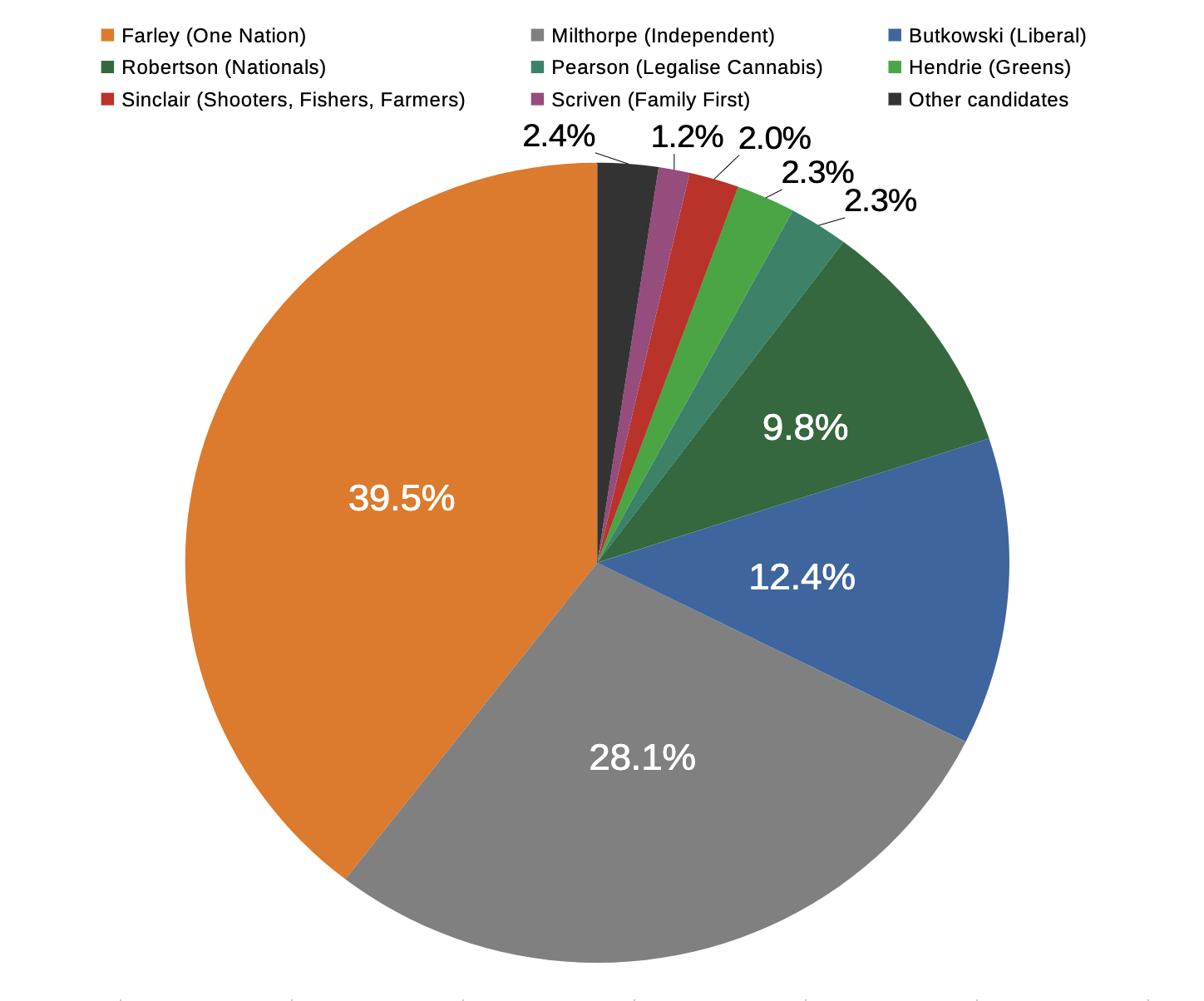
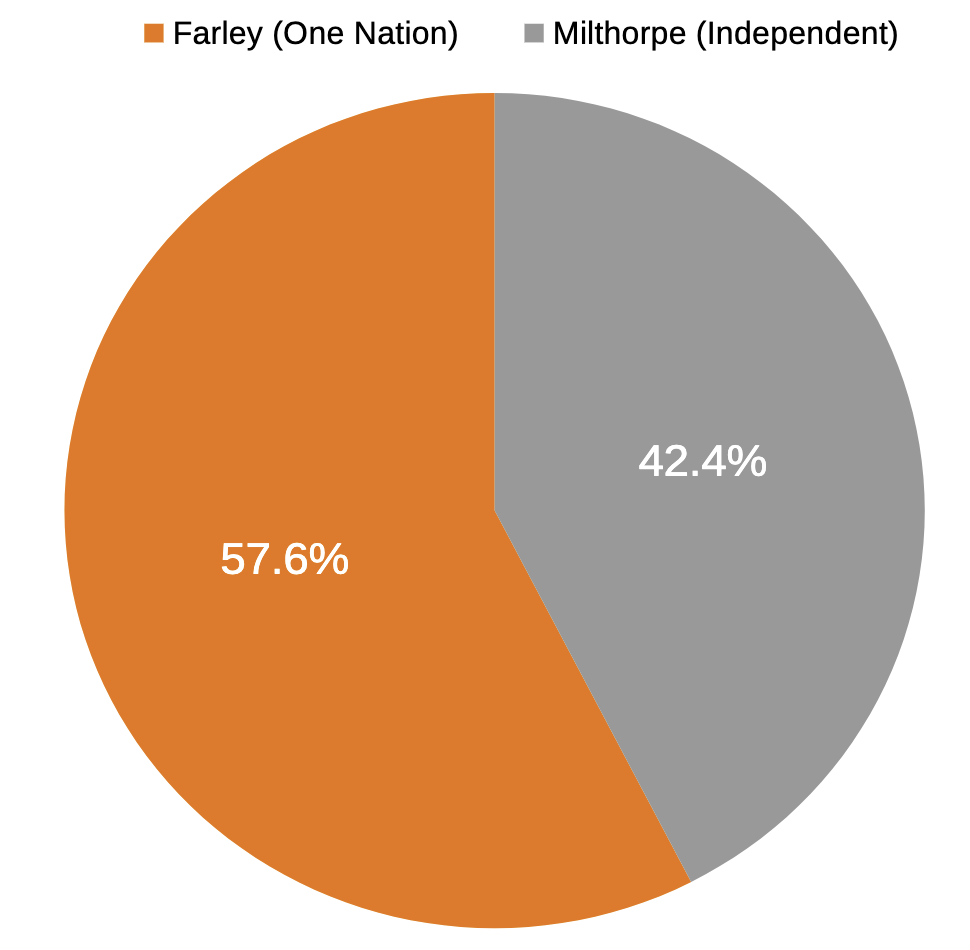
First, here's the first-preference results and the final two-candidate-preferred count.
Source: Australian Electoral Commission
As you can see, One Nation's David Farley polled a strong first on primary votes, enough that independent Michelle Milthorpe would have had to massively outdo him on preferences to win the seat, and the vote total beyond the first two was fragmented enough that the final pairing of Farley and Milthorpe was assured. As previously noted, the Liberal and National parties performed so poorly that there was no chance of them overtaking Milthorpe after preferences.
Preferences split roughly evenly between Farley and Milthorpe, with 55.6% going to Farley and 44.4% to Milthorpe. But now that a full preference flow in Farrer has been published, I think it's worth examining where exactly the preferences came from between them.
If you didn't read my last post, I hypothesised that, based off the results of One Nation in South Australia, they would likely require a strong primary vote lead to be sure of besting the Coalition in the country. When Labor was eliminated from contention in these regional seats, the votes they had accumulated tended to strongly favour the Liberal candidate. This meant that in rural One Nation v Liberal races in South Australia, preferences favoured the Liberal quite strongly.
But what I didn't talk so much about were One Nation v Labor races, and that's because One Nation tended to perform relatively well on preferences in those. Of course, Labor did not stand in the Farrer by-election. This left Milthorpe as the most left-of-centre option in the race. While she disavowed the teal label, she did receive money from groups such as Climate 200, and both Coalition parties preferenced Farley above her.
This is what makes the flow of preferences in Farrer so interesting. So here they are:
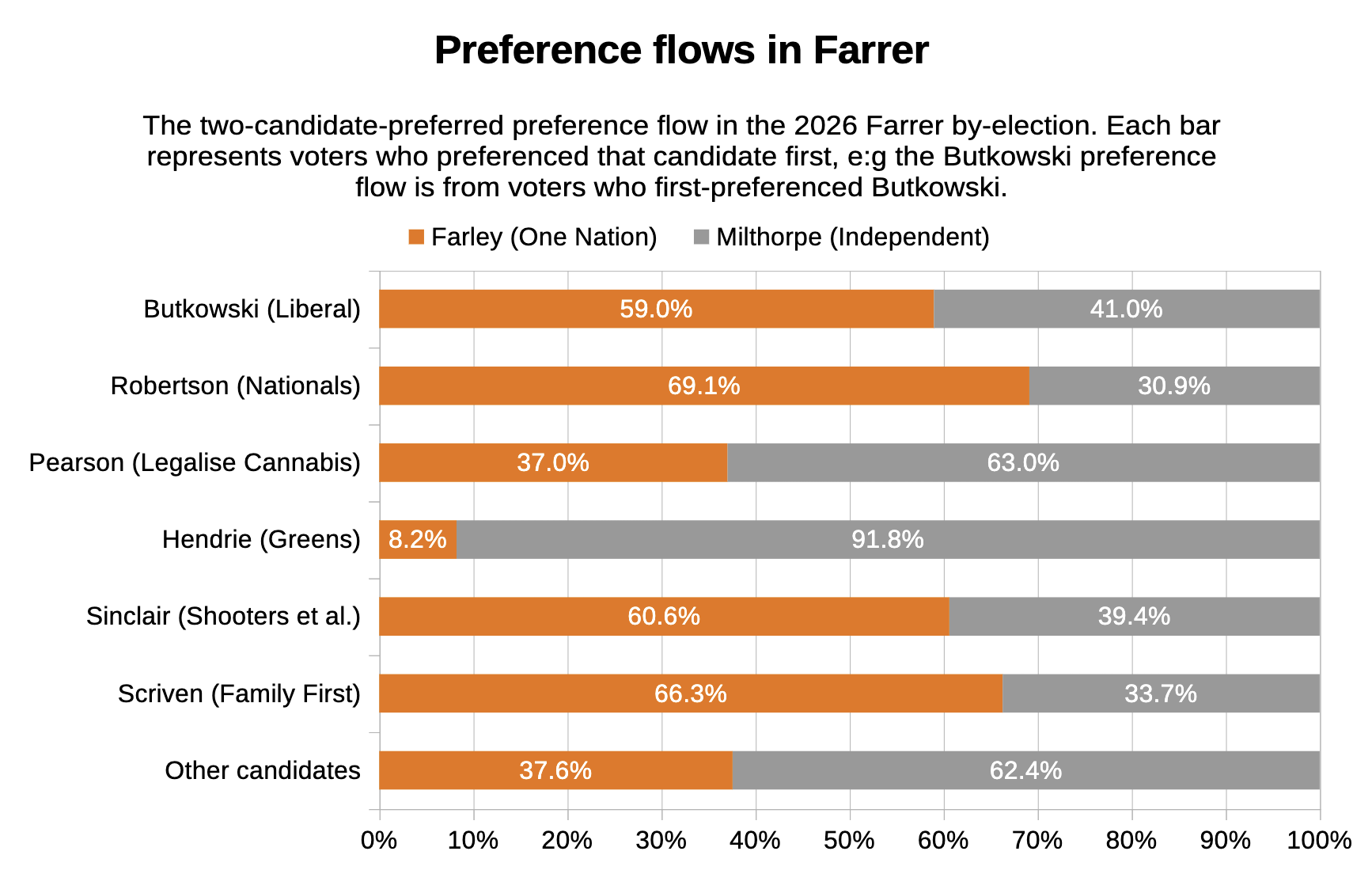
Starting from the bottom, the flow of the handful of minor candidates (two independents, a Sustainable Australia candidate, and one from Gerard Rennick's right-wing People First party) favoured Milthorpe, although these only represent about 2,400 votes in all.
The broadly right-wing Shooters, Fishers, and Farmers Party and Family First also favoured One Nation, which is fairly unsurprising. Family First preferenced Farley over Milthorpe, but did have a grumble about Farley sharing an OnlyFans post on his Instagram. It seems to have not much effected things, in the end.
Legalise Cannabis and the Greens were the two main left-of-centre forces in this by-election. About two-thirds of Legalise Cannabis votes went to Milthorpe, while almost all of the Greens' first preference votes went t0 Milthorpe. The disparity can probably best be explained by Legalise Cannabis picking up a few ideologically diverse protest votes, and the Greens vote being whittled down to the true believers, who would be very unlikely to preference One Nation in any case.
Overall, the non-Coalition preferences in Farrer favoured Milthorpe. 61.4% went to her, as opposed to 38.6% to Farley of One Nation. As shown in the above bar chart, the Coalition preferences were a different story.
More than two-thirds of voters who gave their first preference to Brad Robertson, the Nationals candidate, put Farley over Milthorpe, about 69%. A good deal less Liberal voters did this, although that party's first preferences still favoured One Nation, with 59% of Butkowski's vote going to Farley, and 41% to Milthorpe.
In total, this amounts to 63.5% of Coalition preferences going to Farley, and 36.5% to Milthorpe.
We can compare this to the results in South Australia. There were three regional seats there where Liberal preferences were distributed in a Labor v One Nation final two, but one was Giles, which Labor easily won and where the Liberals polled 9%, so we'll look only at Hammond and Ngajduri, both won by One Nation. Unlike the above figures, these tables show the distribution of preferences accumulated by the Liberal candidate when they were eliminated from the count, not the preferences of those who voted 1 Liberal.
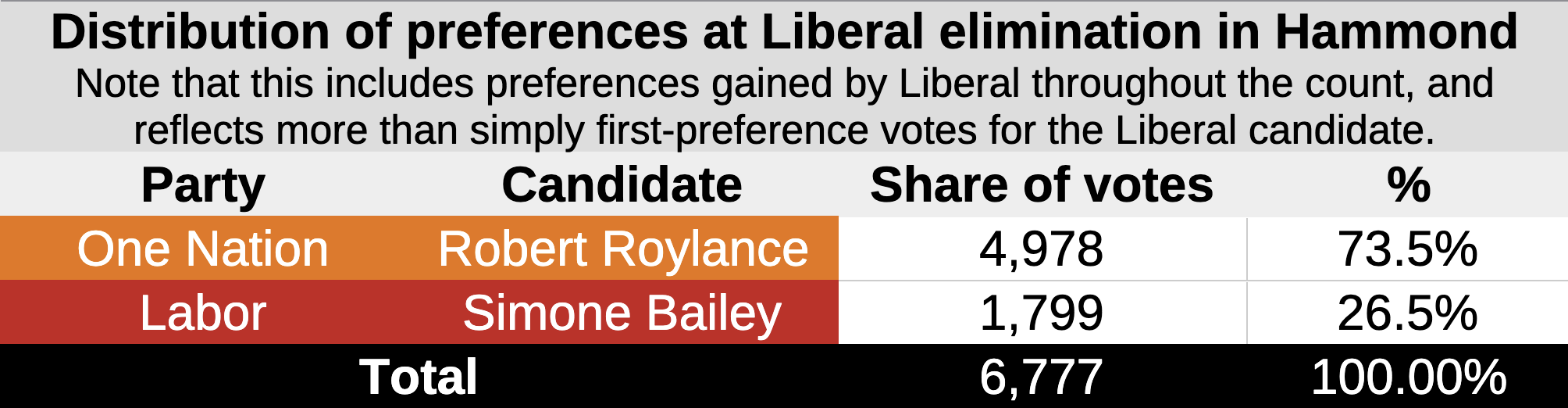
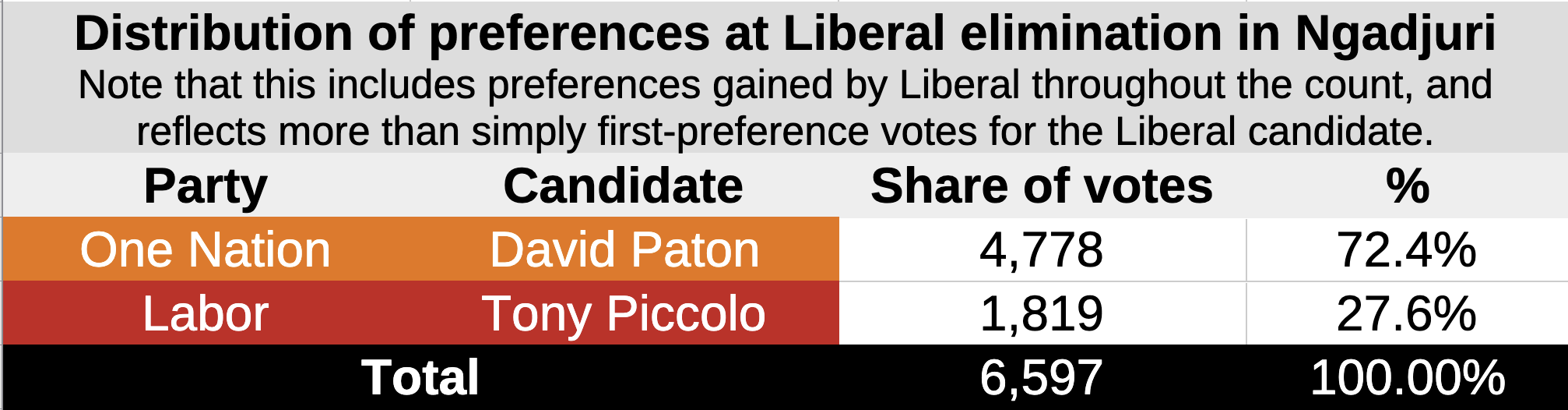
This is a much stronger flow than was seen in Farrer. Of course, the comparison is not exactly like-to-like, for a few reasons. First is that these are different figures – one the preferences on the exclusion of a Liberal candidate, the other the preferences of first-preference Liberal voters. The former might theoretically include a swathe of further-right voters who voted, say, 1 Family First, 2 Liberal, 3 One Nation. But the comparative figure in Farrer – the flow of Butkowski's preferences when she was excluded from the count – was still 61.9% to One Nation, much weaker than these preference flows in South Australia.
The second is that the final count in Farrer was not between One Nation and Labor, it was between One Nation and Michelle Milthorpe. Milthorpe can probably be expected to do better on conservative preferences by virtue of being not affiliated with a left-wing party.
That is an important caveat, but I still believe it's noteworthy that the preference flow from the Coalition to One Nation was weaker than in South Australia. After all, the Liberal Party still preferenced One Nation in South Australia, just as the Coalition did in Farrer.
There is lots of discussion over if the Liberals ought to preference One Nation as the latter rises in prominence. So far, in every major electoral test One Nation has had, the Liberal Party has directed preferences to One Nation over Labor or prominent independents. Newly-elected Liberal party president Tony Abbott has endorsed swapping preferences with One Nation, and it seems likelier than not that the Victorian Liberals will preference One Nation at the coming state election.
Abbott has cited the preference flow between Labor and the Greens as an example of this, but Farrer shows that Coalition voters might not necessarily preference One Nation as much as Labor voters do the Greens. While there are scant few examples of Labor preferences in Liberal vs Greens contests, there was one at the 2025 federal election, in Ryan. In that seat, 77% of first-preference Labor voters put the Greens over the Liberals. In 2022, it was 84.5% in Brisbane, 82% in Griffith, and 83.5% in Ryan. We can use the less precise measure of distributions on a candidate's exclusion to look at state examples – preferences on Labor's elimination in Prahran at the last Victorian state election flowed 83% to the Greens, in the Northern Territory district of Fannie Bay, it was 67.2%.
There's variation here, and an absurdly small sample size (crucially, all of these districts are urban, and the districts of the NT parliament are miniscule), but all have at least a two-to-one flow of preferences from Labor to the Greens. Farrer, of course, has the key difference of having an independent in the final 2CP as opposed to a Labor candidate, so it is not definitively true that Coalition voters preference One Nation less than Labor voters do the Greens. After all, these figures do look similar to the matchups we saw in South Australia, where One Nation gained about ~73% of the vote a Liberal candidate had accumulated on their exclusion. And, to be clear, in Farrer, preferences still favoured One Nation. Out of all the voters who didn't either first-preference David Farley or Michelle Milthorpe, more of them did put Farley over Milthorpe.
But the flow in Farrer from the Coalition to One Nation was weaker than you might expect, and suggests that regional independents could perform meaningfully better than Labor against One Nation. It will be interesting to see what happens at the Victorian state election, where there will likely be a bigger sample size for how preferences flow in two-candidate-preferred races involving One Nation, and whether the Victorian Liberals do ultimately decide to allocate their preferences to One Nation.